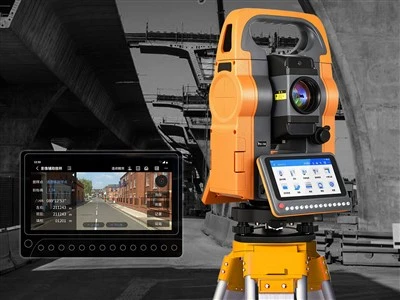

The performance testing of a total station mainly involves a systematic inspection of its angle measurement, distance measurement, and overall stability to ensure that the instrument meets the accuracy requirements of engineering surveying. Testing is typically conducted before use, during periodic calibration, or when abnormal data is encountered.
Angle Accuracy: Using a known angle or standard baseline, the horizontal and vertical angles of the total station are repeatedly observed. The deviation between the observed values and the standard values is compared to evaluate the instrument's angle measurement accuracy. Simultaneously, the vertical axis perpendicularity and line-of-sight error must be checked to ensure the stability and reliability of the angle system.
Distance Measurement Performance: Using a standard baseline of known length, multiple measurements at different distances are performed to verify whether the distance measurement error is within the allowable range, and the stability under different weather and reflection conditions is observed. For prism-less mode, special attention must be paid to the impact of reflection conditions on accuracy.
This also includes testing the overall stability and system function. This includes checking whether the compensator is working properly, whether the automatic centering and focusing are accurate, and whether data storage and transmission are stable. Through these comprehensive checks, it can be determined whether the total station is in normal working condition, ensuring the reliability of field measurement data.