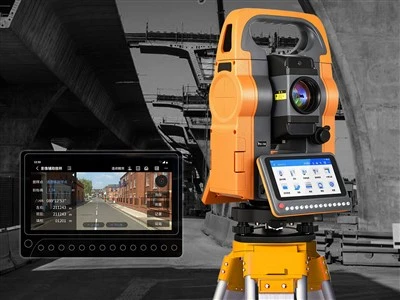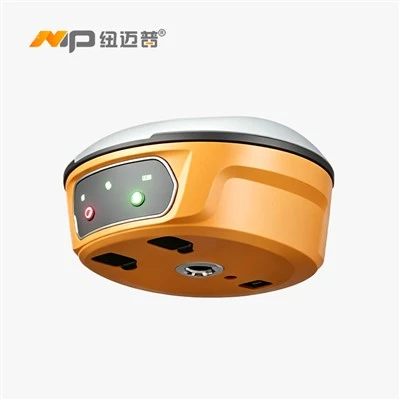

The key technologies of a total station mainly focus on three aspects: angle measurement, distance measurement, and data processing. These technologies determine the instrument's accuracy, efficiency, and application range.
Total stations employ optical or photoelectric encoder systems, measuring horizontal and vertical angles through a rotating telescope. Combined with precision bearings and compensator designs, they achieve sub-arcsecond angle measurements. This technology ensures the accuracy of the measurement direction and is the foundation for precise positioning and three-dimensional measurement.
Modern total stations commonly employ electronic distance measurement (EDM) technology, including reflective and prism-free distance measurement modes. By emitting laser or infrared signals and receiving the returned signals, distance is calculated using the time-of-flight or phase difference principle, achieving high-precision long-distance measurement while adapting to different reflection conditions and ambient lighting.
Total stations have built-in microprocessors and storage systems, enabling real-time processing of angle and distance data, calculation of coordinates, and generation of measurement results. Simultaneously, digital data interfaces and communication technologies allow measurement data to be directly transmitted to computers or measurement software, improving measurement efficiency and data reliability, and providing crucial support for the automation of modern engineering surveying.