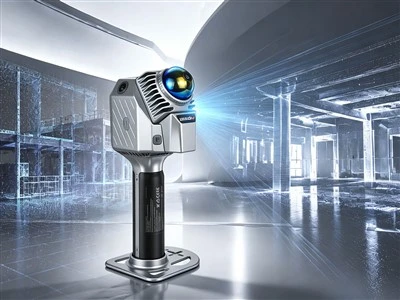

The core principle of a 3D laser scanner is to emit a laser beam and receive its reflected signal, measuring distance by combining the time or phase difference. The main methods include Time-of-Flight (ToF), phase-shifting, and triangulation. The distance calculation formula for the Time-of-Flight method is d = (c * Δt) / 2, where c is the speed of light and Δt is the round-trip time of the laser.
To obtain 3D spatial information, scanning methods must be combined, such as mechanical rotation, multi-beam integration, MEMS micromirrors, optical phased arrays, and Flash LiDAR. By calculating distance and angle information, point cloud data containing spatial coordinates (x, y, z), reflection intensity, and timestamps is generated.
Key technical details include multi-beam scanning, echo intensity analysis, and anti-interference design to achieve millimeter-level ranging accuracy and all-weather operation.
During the technological development process, related research has achieved advancements in areas such as high-precision inertial navigation fusion, high-frequency and wide-field-of-view coordination, the combination of ultra-high-definition imagery and optimization algorithms, as well as pulse-phase hybrid ranging and panoramic scanning methods.
These technologies collectively support the application of 3D laser scanners in high-precision, high-efficiency, and non-contact measurement.